For years, the standard advice for landing a job at a top tech company has been simple: "Grind LeetCode until your eyes bleed." We spend months memorizing obscure algorithms, re-learning binary search implementations, and burning out on medium-difficulty problems, only to enter the interview room and find ourselves struggling to apply that abstract knowledge to a real-world scenario.
The truth is, coding interview preparation is broken. It incentivizes pattern matching over problem-solving. But you don't have to play the game the way everyone else is losing it. Here is a better way to prepare that actually moves the needle.
The "Pattern Recognition" Trap
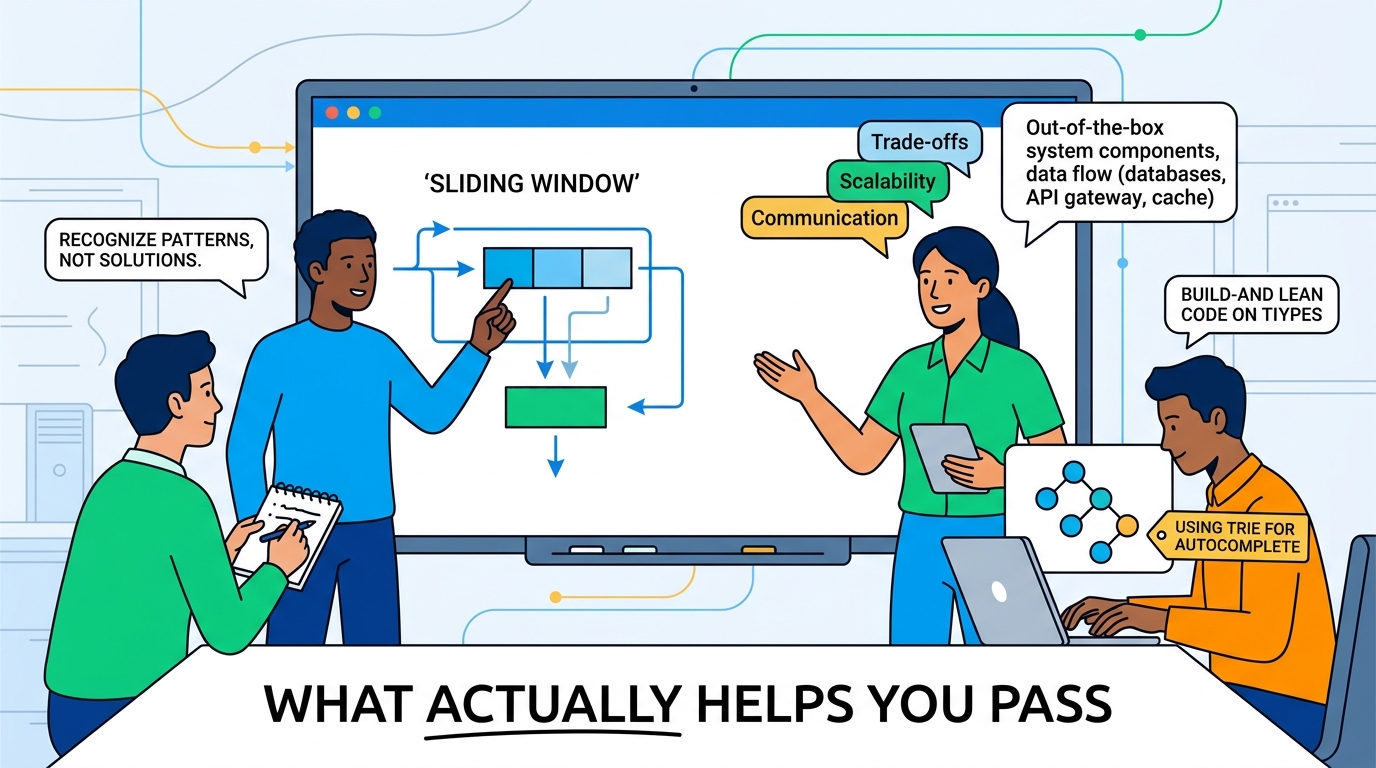
Many developers fall into the trap of trying to memorize 500+ LeetCode problems. The issue? When the interviewer tweaks the constraints just slightly, you’re stuck because you didn't learn the —you learned the .
logic
solution to that specific variation
To break this cycle, stop counting the problems you've solved and start categorizing the patterns. Whether it’s sliding windows, two-pointers, or topological sorts, understanding the "why" behind the tool is infinitely more powerful than memorizing the code.
1. Adopt the "Whiteboard-First" Mentality
When you sit down to code, don't open your IDE. Seriously.
In a real interview, you won't have syntax highlighting or autocomplete. Practice solving problems with pen and paper or a simple text editor. This forces you to think through your variable names, edge cases, and logic flow before a single line of code is written.
2. Talk Through Your Thought Process
Interviews aren't just about the code; they are about communication. If you solve a problem silently in record time, you’ve actually failed.
The interviewer wants to see how you troubleshoot, how you handle frustration, and how you articulate complex ideas. Practice "rubber ducking" out loud while you code. If you aren’t talking, you’re just a script, not a collaborator.
3. Prioritize System Design Over Pure Syntax
If you’re aiming for mid-level or senior roles, raw algorithm knowledge won't save you if you can't architect a scalable system.
Shift your focus to understanding:
Trade-offs: Every technical choice (SQL vs. NoSQL, Caching, Load Balancing) has a cost. Can you explain yours?
Scalability: What happens when the user count jumps from 100 to 1,000,000?
Maintainability: How will other engineers work with your code six months from now?
4. Build, Don’t Just Study
The most effective way to understand data structures isn't just watching a lecture—it's using them to build something functional.
Build a mini-project that requires a Trie structure or a custom Hash Map. When you see how these concepts improve (or break) a real application, they stop being abstract requirements and start being practical tools in your belt.
The Bottom Line
Passing the coding interview shouldn't feel like a high-stakes test of your ability to memorize puzzles. By focusing on fundamental patterns, vocalizing your logic, and prioritizing system design, you aren't just "beating the system"—you’re becoming a better engineer.
Don't prepare for a test. Prepare for the job.
Are you tired of the LeetCode grind? Let us know in the comments what your favorite (or least favorite) part of the interview process is.